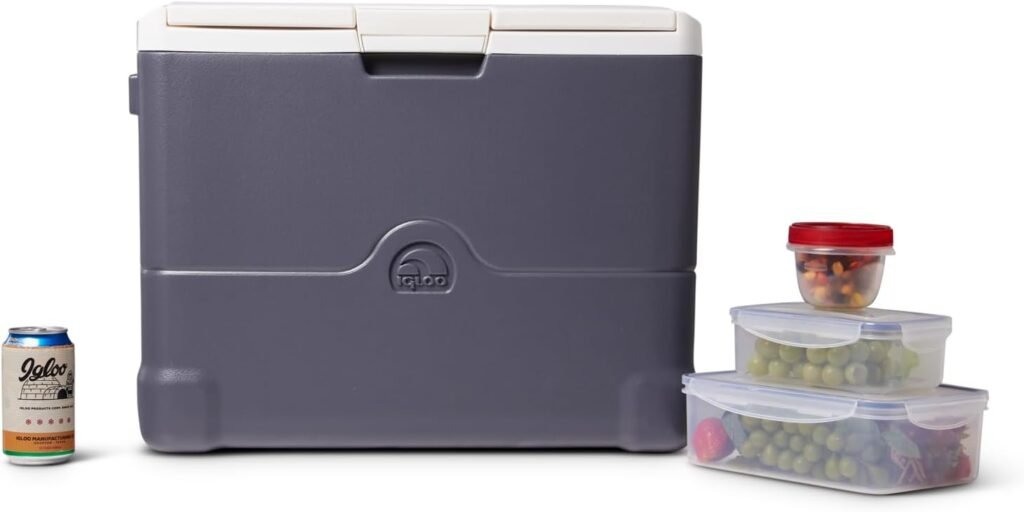
The Igloo Iceless 40 Qt Cooler is a large thermoelectric cooler for drivers who want to keep drinks and packed food cool without buying bags of ice. It plugs into a vehicle’s 12V accessory socket, holds up to 52 standard cans according to Igloo, and can be positioned horizontally like a chest or vertically like a small refrigerator.
Quick answer: It is a practical choice for long drives, work vehicles, and campsites with reliable power. It is not a true freezer, and its performance depends on ambient temperature. Buyers expecting compressor-refrigerator performance should choose a different category.
Amazon disclosure: As an Amazon Associate, ACCGO may earn from qualifying purchases. Prices, sellers, coupons, and availability can change at any time.
Editorial note: This article evaluates manufacturer specifications and practical ownership considerations. ACCGO did not perform a controlled temperature test for this review.
Quick Verdict
| Buy it if… | Skip it if… |
|---|---|
| You want cooling without melting ice and wet food | You need freezing or precise temperature control |
| Your vehicle has a dependable 12V outlet | You regularly leave the cooler in a parked vehicle without power |
| A roomy 40-quart interior suits your trips | You need a lightweight personal cooler |
| You understand thermoelectric cooling limits | You expect the same performance as a compressor refrigerator |
The Igloo Iceless 40 Qt works best when convenience matters more than extreme cooling. It removes the recurring ice purchase, preserves interior space that would otherwise be filled by ice, and avoids a puddle at the end of the trip.
Key Specifications
| Feature | Manufacturer information |
|---|---|
| Capacity | 40 quarts / 37 liters |
| Can capacity | Up to 52 standard 12-ounce cans |
| Cooling claim | Interior up to 38°F below ambient temperature |
| Power | Vehicle 12V accessory connection |
| Orientation | Horizontal chest or vertical refrigerator-style use |
| Weight | Approximately 18.75 lb empty |
| Exterior dimensions | Approximately 21.88 x 15.25 x 16.75 inches |
| Indoor power | Optional 110V AC converter is not included with the standard configuration |
Specifications and bundles can change. Confirm the current Igloo and Amazon listings before publication or purchase.
How Cold Does It Get?
Igloo describes the cooler as capable of cooling its interior to as much as 38°F below the surrounding temperature. The phrase below ambient is more important than the number alone.
If the air around the cooler is 75°F, idealized performance may be suitable for chilled drinks. If the vehicle interior climbs far above 90°F, the resulting interior temperature can also rise. Thermoelectric coolers do not behave like compressor refrigerators that actively target and hold a selected temperature across a broad range of conditions.
Real performance depends on:
- starting temperature of the food and drinks
- outside and vehicle temperature
- direct sunlight
- how often the lid is opened
- airflow around the cooler
- voltage supplied by the vehicle
- how tightly the cooler is packed
Pre-chilling food and drinks at home is more effective than asking the cooler to pull warm groceries down to a safe temperature inside a hot car.
Food-Safety Limits Matter
An electric cooler should not be treated as proof that perishable food is safe. Use a separate refrigerator thermometer and follow current USDA food-safety guidance. If the interior cannot remain within a safe refrigeration range, move perishable items to dependable refrigeration or use sufficient ice in an appropriate cooler.
Never rely on appearance or smell alone to judge food safety. Extra caution is appropriate for meat, dairy, prepared food, infant food, and medication. Medication storage should follow the product label and professional guidance rather than a general cooler review.
Capacity in Everyday Use
The 40-quart interior is large enough for a family road trip, work crew, picnic, or multi-day supply of drinks. Igloo’s 52-can figure communicates volume, but most owners will use a mix of bottles, containers, fruit, and snacks.
The adjustable shelf becomes more useful in vertical orientation, where it can reduce stacking and make frequently used items easier to reach. In chest orientation, heavier items can sit low while delicate food remains near the top.
The trade-off is weight. At roughly 18.75 pounds before loading, it can become awkward when filled. Pack it close to the vehicle, use both handles, and avoid lifting a fully loaded cooler alone if the weight is uncomfortable.
12V Power and Parked-Car Use
The standard cooler plugs into a vehicle 12V accessory outlet. Whether that outlet remains active when the engine is off depends on the vehicle.
Leaving a cooler connected can discharge the starter battery if the socket stays powered. Check the vehicle manual, understand the outlet behavior, and unplug the cooler when appropriate. A dedicated battery-management or portable-power solution may be useful, but compatibility must be verified rather than assumed.
Readers building a wider power kit can consult ACCGO’s Anker SOLIX C300 DC review and NOCO Boost X GBX45 review. The first discusses mobile power, while the second covers a dedicated jump starter. Neither should be presented as automatically compatible with this cooler without confirming voltage, connector, continuous current, and manufacturer instructions.
Horizontal or Vertical?
Dual orientation is one of the Igloo’s most practical features.
Use it horizontally when:
- the cooler is in a vehicle cargo area
- you want conventional top access
- tall items are not needed
- stability during transport is the priority
Use it vertically when:
- it is stationary at a campsite, office, or workshop
- shelf organization matters
- you have sufficient clearance for the door and ventilation
Secure the cooler so it cannot slide or tip during driving. Keep the power cord away from hinges, seat tracks, feet, and cargo that could pinch it.
Noise and Ventilation
Igloo specifies a brushless motor and positions the product as quiet, but it is not silent. A fan must move air for thermoelectric cooling, so users may hear a steady low mechanical sound.
That is unlikely to matter in a moving vehicle. It may be more noticeable in a quiet hotel room, office, or sleeping area. Leave space around ventilation areas and never bury the cooler under blankets or tightly packed luggage.
Cleaning and Odor Control
The absence of melting ice makes routine cleanup easier. Empty the cooler after use, wipe interior and exterior surfaces, and allow it to dry before storage. Igloo recommends water or mild detergent for light cleaning and a diluted baking-soda solution for tougher odors or stains.
Do not immerse the powered portion or allow liquid into electrical components. Confirm the care instructions supplied with the exact model.
Iceless Cooler vs Regular Ice Chest vs Compressor Cooler
| Type | Best for | Main limitation |
|---|---|---|
| Igloo thermoelectric cooler | Long drives with steady 12V power and pre-chilled contents | Cooling depends on ambient temperature |
| Traditional ice chest | Simple use without electricity | Ice takes space, melts, and must be replaced |
| Compressor cooler | Stronger cooling and controllable temperatures | Higher cost, weight, and power complexity |
ACCGO’s YETI Roadie 15 review is a useful next read for shoppers comparing this electric approach with a smaller premium ice chest.
Pros and Cons
Pros
- No bags of ice required during powered use
- Large 40-quart interior
- Up to 52-can manufacturer capacity claim
- Horizontal and vertical placement
- Adjustable interior shelf
- Straightforward 12V vehicle connection
Cons
- Temperature depends on ambient conditions
- Not a freezer or compressor refrigerator
- Heavy when fully loaded
- Can drain a vehicle battery if left powered incorrectly
- Optional household AC converter is not included in the basic configuration
Who Should Buy It?
The Igloo Iceless 40 Qt is best for drivers, delivery workers, families, campers, and sports-day users who have reliable 12V power and start with cold contents. It is also useful where the mess and recurring cost of ice are the main frustrations.
Skip it if you need verified refrigerator temperatures in extreme heat, freezing capability, battery operation without an external power source, or a compact cooler that one person can carry easily when full.
Complete the Road-Trip Setup
For vehicle electronics and charging, continue to ACCGO’s Anker SOLIX C300 DC review. Dog owners planning the same journey should read the Ruffwear Load Up Dog Car Harness review, which explains the important difference between a manufacturer crash test and independent CPS certification.
Final Verdict
The Igloo Iceless 40 Qt Cooler is worth considering when your goal is convenient, ice-free cooling during powered travel. Its roomy interior, dual orientation, and simple 12V connection suit long drives and everyday vehicle use.
The deciding factor is expectation. It is a thermoelectric cooler whose temperature follows ambient conditions—not a portable freezer. Use a thermometer, start with cold contents, protect it from heat, and manage vehicle power carefully.
FAQ
Does the Igloo Iceless 40 Qt use ice?
It is designed to cool with electricity and does not require ice during normal powered use.
How cold does it get?
Igloo states that the interior can cool to as much as 38°F below ambient temperature. Actual results depend on weather, ventilation, starting temperature, and use.
Can it run when the car is off?
That depends on whether the vehicle’s 12V socket remains powered. Leaving it connected may drain the starter battery. Check the vehicle manual.
Can I plug it into a household outlet?
The standard unit uses 12V vehicle power. Igloo lists an optional 110V AC converter, which is not included in the standard package.
Is it safe for meat and dairy?
Only when a thermometer confirms that the contents remain at a safe temperature. Follow USDA food-safety guidance and do not rely solely on the cooler’s power light.
By Kevin; Accgo doesn’t simply review products—we look at whether they genuinely make everyday life easier.