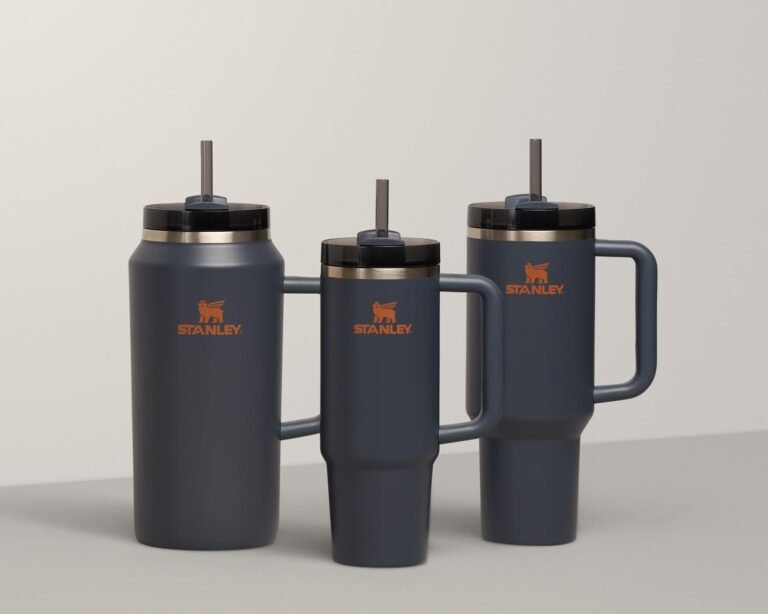
The Stanley Quencher H2.0 FlowState tumbler is less a statement product than a study in incremental refinement. Its design doesn’t attempt to push insulation technology forward, nor does it aim to replace the traditional sealed thermal bottle. Instead, it reflects a clear understanding of how insulated drinkware is commonly used in modern, largely sedentary routines.
That focus shapes every major design decision.

The Quencher’s double-wall stainless steel construction delivers the expected level of durability and insulation for this category. It is notably heavy when filled, a characteristic that reinforces its intended role as a surface-bound object rather than a portable one. This is not a bottle meant to disappear into a backpack.
The integrated handle and tapered base reinforce that assumption. The handle improves control when lifting the cup from a desk or car console, while the narrowed base allows it to fit into standard vehicle cup holders — a practical accommodation that many large-capacity tumblers still overlook. Together, these elements suggest a product optimized for predictable, repeatable movement rather than dynamic travel.

Lid Design and Tradeoffs
The FlowState lid employs a rotating, three-position system that supports straw use, open sipping, and a closed orientation designed to reduce spills. Mechanically, the system is straightforward and reliable. The rotation has enough resistance to prevent accidental movement, and the drinking experience remains consistent across modes.
What the lid does not attempt is full containment. This is not a leakproof design, and it is not presented as one. The choice favors convenience and ease of access over transport security, which limits how and where the tumbler can reasonably be used. In practice, it performs best when kept upright and within sight.
Thermal Performance in Context
Insulation performance aligns with category expectations rather than exceeding them. Cold beverages remain chilled for several hours, especially with ice, and hot drinks maintain usable warmth over a typical morning or afternoon. This is adequate for frequent, incremental consumption but less suited to long-term heat retention.
Importantly, this level of performance appears intentional. A more tightly sealed system would likely compromise the accessibility that defines the Quencher’s design. In that sense, thermal efficiency is balanced, not maximized.
Maintenance and Longevity
Straw-based systems often introduce complexity in cleaning, but the FlowState lid avoids unnecessary intricacy. Components are easily removable, and the internal geometry is simple enough to discourage residue buildup. Over extended use, this simplicity may prove more consequential than marginal gains in insulation.
Why we like it
The Stanley Quencher H2.0 FlowState tumbler is thoughtfully optimized for predictable, everyday use. Its size, handle, and tapered base work together to make a large-capacity cup feel manageable in desk and car settings. Unlike many oversized tumblers, it fits securely into standard vehicle cup holders, which significantly expands where it can be used without adjustment.
The FlowState three-position lid prioritizes accessibility. Switching between straw use and open sipping is quick and intuitive, encouraging frequent, low-effort hydration. The system is mechanically simple, with few moving parts, and proves easier to clean than many straw-based alternatives. Insulation performance is consistent and reliable for daily consumption patterns, keeping cold drinks chilled and hot drinks warm for several hours without requiring a tightly sealed lid.
Taken together, these choices suggest a product designed around real habits rather than edge-case performance.
Conclusion
The Stanley Quencher H2.0 FlowState is best viewed as a product shaped by behavioral observation rather than technical ambition. It assumes its user will drink often, remain mostly stationary, and value frictionless access over secure transport.
For those conditions, its design is coherent and internally consistent. Outside of them, its limitations become more apparent. The tumbler neither overpromises nor attempts to adapt beyond its intended use case — a restraint that ultimately defines both its appeal and its boundaries.
By Jessica Borga. Accgo doesn’t simply review products—we look at whether they genuinely make everyday life easier, especially for people living in Canada.