For years, Roomba was the safe answer. If someone asked which robot vacuum to buy, the response was simple: get a Roomba and you’ll be fine.
But in 2026, the market looks very different. Roborock, Ecovacs, and others now offer stronger suction, more aggressive pricing, and feature-packed docks. So the real question isn’t whether Roomba still works — it does — but whether it still makes sense at today’s prices.
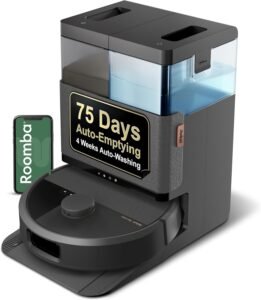
To answer that, I spent time looking specifically at one of iRobot’s newest and most ambitious models: the iRobot Roomba Combo Robot Vacuum with AutoWash Dock, the model many Canadian shoppers are currently eyeing on Amazon.
This isn’t a budget Roomba. It’s designed to be a hands-off, do-everything cleaner:
-
Vacuums and mops in one pass
-
Uses smart navigation and obstacle avoidance
-
Empties its own dustbin
-
Washes and dries its mop pads automatically
In other words, this is iRobot’s answer to the new generation of “self-maintaining” robot vacuums — the kind you’re supposed to barely think about once it’s set up.
And in daily use, that goal mostly lands.
Cleaning performance: dependable, not flashy
Roomba has never chased raw suction numbers, and that’s still true here. On paper, competitors often look stronger. In real homes, though, this model delivers predictable, even cleaning, which is something specs don’t always capture.
-
On hardwood and tile, dust pickup is consistent and edges are handled well
-
On carpet, it doesn’t feel aggressive, but it’s thorough
-
Pet hair is handled reliably without frequent tangles
This is classic Roomba behavior: it may not impress in a side-by-side suction test, but it rarely leaves obvious misses behind.
If you want a robot that looks powerful on a spec sheet, there are better options. If you want one that quietly gets the job done day after day, this still plays to Roomba’s strengths.
The AutoWash Dock is the real selling point
The AutoWash Dock is where this model earns its price.
It does four things automatically:
-
Empties the dustbin
-
Washes the mop pads
-
Dries the pads to prevent odors
-
Prepares the robot for the next run without user input
In practice, this dramatically reduces maintenance. You’re not rinsing pads after every run, and you’re not emptying bins every few days. For busy households, that matters more than an extra bump in suction power.
It’s not silent, and it’s not small — but it works exactly as advertised.
Navigation and smarts: solid, not cutting-edge
Roomba’s navigation here is reliable and cautious.
-
Mapping is accurate
-
Rooms are identified correctly
-
Obstacle avoidance works well for everyday clutter
What it doesn’t do is push boundaries. Some competitors feel more aggressive in path optimization or app customization. Roomba’s app, however, remains one of the easiest to live with, especially for users who don’t want to tweak settings constantly.
This is very much a “set it once and forget it” system — intentionally so.
Where Roomba starts to feel expensive
This is where the 2026 conversation gets complicated.
At its current Amazon Canada pricing, this Roomba sits in a range where:
-
Some rivals offer stronger suction
-
Some rivals offer more advanced dock automation
-
Some rivals undercut it by a noticeable margin
So what are you paying for?
You’re paying for:
-
Brand reliability
-
Consistent software updates
-
A conservative approach that prioritizes stability over experimentation
Whether that’s worth it depends entirely on the buyer.
Who should buy this Roomba in 2026
This Roomba makes sense if:
-
You want minimum maintenance above all else
-
You value reliability over raw specs
-
You’ve had Roombas before and liked the experience
-
You want vacuuming + mopping without micromanagement
You may want to look elsewhere if:
-
You’re chasing the best value per dollar
-
You want maximum suction or bleeding-edge features
-
You enjoy tweaking settings and optimizing performance
Final verdict: is it still worth it?
Yes — but for the right buyer.
The Roomba Combo Robot Vacuum with AutoWash Dock isn’t trying to win on paper. It’s trying to be the robot you don’t think about, don’t babysit, and don’t troubleshoot often. In that role, it succeeds.
In 2026, Roomba is no longer the automatic best choice. But if what you want is a dependable, low-effort cleaning system backed by a mature ecosystem, this model still earns its place — even in a crowded, more competitive market.
If peace of mind matters more to you than specs, Roomba is still worth buying.
By Jessica Borga. Accgo doesn’t simply review products—we look at whether they genuinely make everyday life easier, especially for people living in Canada.